Checking It Yourself
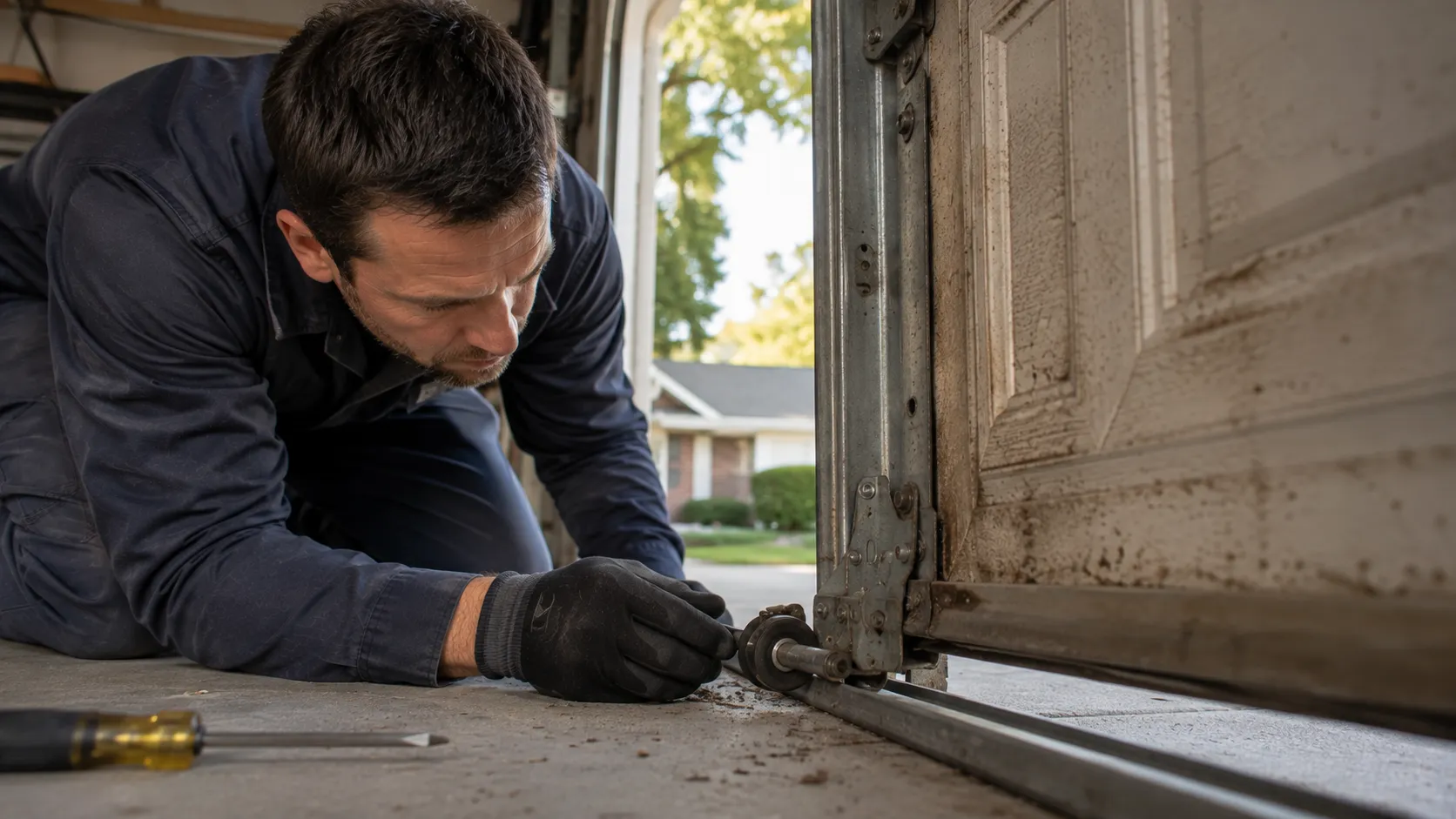
Before you call anyone, look at the spring itself. Most houses in this part of Plano went up between 1973 and 2015, with the bulk of the stock dating to the 2000s, so you're almost certainly looking at a torsion spring mounted on a shaft above the door, not the older side-mounted extension springs you'd find on a house from the 1960s. Check for a visible gap in the coil - a broken torsion spring shows a clean separation, usually right at the winding cone. If the door won't budge, or it feels twice as heavy when you try to lift it by hand with the opener disconnected, that's your answer. Don't try to wind or unwind the spring yourself. These are under real tension and a cone that lets go while you're working on it can take a finger off. One honest limit here: if the spring is original to a house built in the early 2000s, it's likely lived its full cycle life already, and replacing just the one that broke often means the other one goes within a season or two.
What Is Going On
A torsion spring is rated for a set number of open-close cycles, and steel fatigues faster at the ends of that range - right when it's brand new and worn-in, and right when it's near the end of its life. The 2000s-era stock that makes up most of Plano's housing is now old enough that a lot of these springs are approaching or past their rated cycle count. Cold doesn't cause the fatigue, but it's often the thing that finishes the job. Steel contracts as it cools, which stiffens the coil and reduces how much the spring can flex before it snaps. A spring that had a hairline crack sitting quietly through a warm year can go the first cold morning it's asked to do full work at reduced flexibility.
The Seasonal Bit
Plano sits in a climate band where heat, not cold, is the dominant stress on a garage door system most of the year - the metal spends far more days expanding in high heat than contracting in a freeze. That matters because the springs and hardware installed on homes here, especially the 1990s-through-2010s builds that make up most of the area, are generally sized and tempered for a heat-dominant climate, not for repeated hard freezes. So when a real cold snap does move through, it's an outlier event for the hardware, not something it cycles through every week the way it would in a colder-climate market. That's part of why a cold-weather spring failure here tends to catch owners off guard - it's not the kind of weather the system deals with routinely.
What the Weather Here Does to It
Because Plano's climate leans toward moderate heat rather than sustained cold, the failure pattern we see isn't the slow, repeated freeze-thaw cracking you'd get somewhere with a real winter. It's more often a spring that was already fatigued from years of heat-cycle stress, pushed past its limit by one sharp temperature drop. The metal doesn't have the redundancy built in that colder-climate hardware would have, because it isn't designed against that stress in the first place. If your door is original to a home built anywhere from the 1970s through the mid-2000s, and you get one of the area's rare cold mornings, that's exactly the moment an aging spring is most likely to let go. Homes in this income bracket around Plano often already carry a heavier-than-average opener setup, which adds load the spring has to compensate for.
Talk to a local pro
Garage door trouble in Plano?
Same-day service with honest, upfront quotes.